The Tides That Bind: How the Lowcountry Marshes Protect and Define Us
The Rhythms of Pluff Mud
To live in the Lowcountry is to live by the clock of the moon. Twice a day, the Atlantic Ocean pulls back its heavy curtain, revealing a landscape that is neither entirely land nor entirely sea. It is a world of winding tidal creeks, swaying spartina grass, and the unmistakable, sulfurous scent of pluff mud—the rich, dark, and ancient silt that forms the very foundation of our coastal identity.
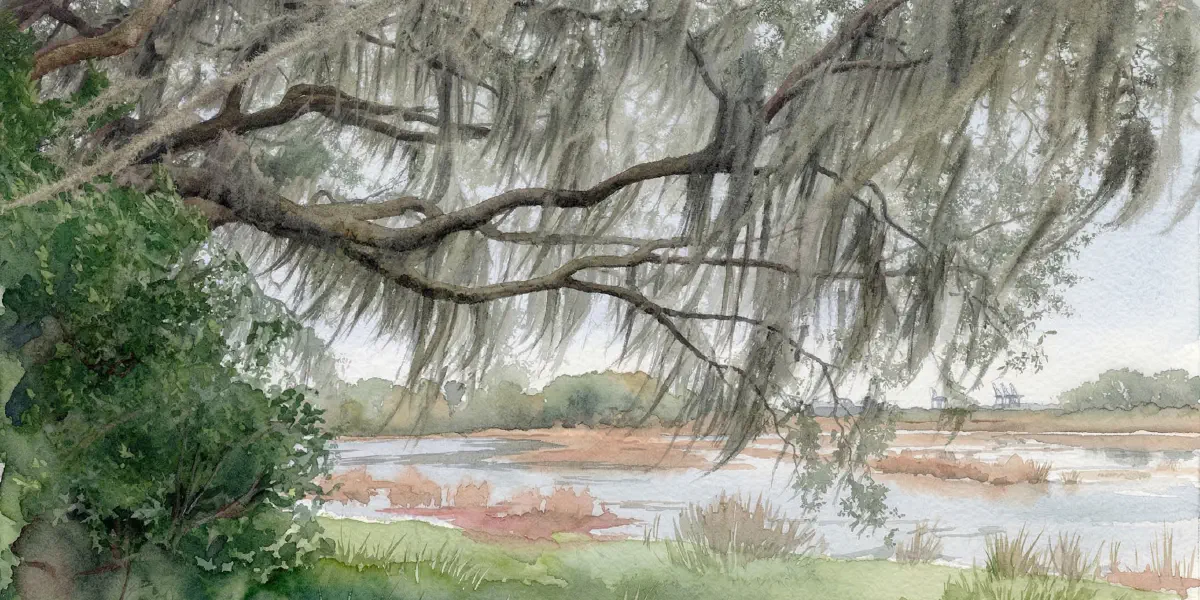
To the uninitiated, the marsh at low tide might seem like a desolate expanse of grey-brown muck. But to those who have spent their lives beneath the Spanish moss, the pluff mud is a sensory symphony. It is the sound of thousands of tiny fiddler crabs scurrying across the banks, their claws clicking like castanets. It is the sight of a snowy egret standing motionless in a shallow pool, a white flame against the muted tones of the earth. And it is the feeling of that mud between your toes—cool, thick, and surprisingly supportive—as you navigate the edges of a creek. This is the breath of the Lowcountry, a rhythmic rise and fall that has defined life here for centuries.
Our Crucial Coastal Guard
While the marsh is undeniably poetic, it is also profoundly practical. Beyond its atmospheric beauty, the coastal wetlands of South Carolina and Georgia serve as a vital, living shield for our inland communities. This vast expanse of salt marsh acts as a natural buffer against the raw power of the Atlantic. During hurricane season, these wetlands absorb the energy of storm surges, significantly reducing the impact of flooding on our historic homes and modern neighborhoods. Without the marsh, the Lowcountry as we know it would simply wash away.
Furthermore, the marsh is the ultimate nursery. An estimated 75 percent of all commercial seafood species in the United States spend at least part of their lives in the protective embrace of coastal wetlands. Within these winding channels, young shrimp, blue crabs, and red drum find sanctuary from larger predators and a wealth of nutrients to fuel their growth. The spartina grass itself is a marvel of evolutionary engineering, filtering pollutants from the water and trapping sediment to build new land. To protect the marsh is to protect our economy, our food security, and our very survival on this fragile coast.
Celebrating International Water Day
Today, as we celebrate International Water Day, it is essential to connect our local love for the Lowcountry to the global challenge of water conservation. While our region is blessed with an abundance of water, the health of our tidal systems is increasingly under threat. Rising sea levels, plastic pollution, and the pressures of rapid development all weigh heavily on our “Tides That Bind.”
International Water Day reminds us that water is not just a resource to be managed, but a sacred trust to be protected. In the Lowcountry, our water is salt-flavored and tide-driven. It is the water that flows through our creeks, sustains our oyster beds, and reflects the sprawling branches of our live oaks. By choosing to live sustainably, supporting local conservation efforts, and respecting the delicate balance of our estuaries, we contribute to a global movement that values water as the lifeblood of our planet. We are part of a larger story—one where the health of a single tidal creek in Beaufort is inextricably linked to the purity of a river in the Highlands or the depth of the open ocean.
A Call to the Water’s Edge
The best way to appreciate the vital importance of the Lowcountry marsh is to experience it firsthand. You must see the way the light catches the grass at sunset, turning the entire world into a sea of liquid gold. You must hear the silence of the marsh at dawn, broken only by the occasional splash of a surfacing dolphin.
We invite you to step away from the pavement and find your way to the water’s edge. Whether it’s a quiet paddle through a wildlife refuge, a guided eco-tour of the barrier islands, or a simple walk along a marsh boardwalk, the experience will stay with you long after the tide has come back in.
Discover the wild soul of the South for yourself. Explore our curated guides to Things To Do and book an experience that will deepen your connection to the water that defines us all.